
This document has been developed with support from the Case Management Support Service (CMSS) is a partnership between Children 1st and sportscotland, established to support Scottish governing bodies of sport (SGBs) to manage investigations and disciplinary processes around wellbeing and protection concerns for children and adults in Mountaineering activities. CMSS provide advice, training, guidance, templates, and consultancy in developing organisational practice to keep children and adults safe in sport.
This resource has been co-designed with the expertise of colleagues within Children First, informed by SGBs, and created alongside Kyniska Advocacy, where we are very grateful for everyone’s support, contributions and insight. We would also like to acknowledge the learning and resource templates gained from ACAS, CIPD and the Ann Craft Trust.
This document has been co-designed and created for Scottish governing bodies of sport [SGBs] to establish and embed national practice in Adult Wellbeing and Protection in Sport. Many SGBs will already have policies and procedures in supporting Vulnerable Adults, either as standalone documents or attached with Child Wellbeing and Protection policies and procedures. We understand the need to ensure that safe practice for all adults that are volunteering, working, or participating in our sporting environments is widespread. Many existing resources and examples of best practice have been explored in developing this template, which once embedded with SGBs can be adapted and cascaded for their members and clubs.
The Case Management Support Service worked with Kyniska Advocacy, bringing lived experience of adults who have reported concerns about wellbeing and protection within sport. This has informed various aspects of the policy and procedures to ensure SGBs are able to respond in the best way possible.
The templates provide:
The remaining content of the document includes a range of definitions and relevant legislation in Supporting Information section and concludes with Resources and Signposting to offer various points of help and support across a spectrum of wellbeing and protection concerns. All of the content across these templates can be shaped and amended to suit the nature of each SGB and their associated members and clubs.
The Case Management Support Service can be contacted on 0300 373 1080 or at cmss@childrenfirst.org.uk for support around the implementation of Adult Wellbeing and Protection in Sport policy and procedures. Further resources and training from the service can be found at: www.childrenfirst.org.uk/cmss
This policy is designed to communicate Mountaineering Scotland’s commitment to ensure everyone who works, volunteers, participates, and performs in our sport can do so in a safe and inclusive environment. We are committed to creating and maintaining safe and positive environments where people feel they can share concerns about their own or other adult’s wellbeing and protection without fear. We believe that promoting the wellbeing and protection of adults is everybody’s responsibility, and we are committed to preventing abuse, neglect, bullying and harassment of all adults involved in Mountaineering activities.
By demonstrating our commitment, we want to ensure that all members and affiliated clubs have a consistent approach to adult wellbeing and protection. Our aim is to make the wellbeing and safety of adults a shared and collective responsibility.
This policy is upheld by:
The Adult Wellbeing and Protection and procedures apply to all individuals involved in Mountaineering Scotland including board members, staff, coaches, volunteers, officials, members, athletes, and participants, and apply to all concerns about the wellbeing and protection of adults whilst taking part in our organisation, its activities and in the wider community.
To implement this policy, Mountaineering Scotland will:
This Code of Conduct details the behaviours, standards and practices required by all Mountaineering Scotland board members, staff, coaches, volunteers, officials, members, athletes, participants, and clubs.
All concerns about breach of this Code of Conduct will be taken seriously and responded to in line with Mountaineering Scotland procedures for responding to a concern about an adult's conduct.
This code of conduct can be used in line with any pre-existing codes of conduct that are role specific. The list below is not exhaustive.
| Expected Conduct |
|---|
|
| Unacceptable Conduct |
|---|
|
Adults across society and communities are involved in sport in a range of different ways and contribute to various roles, paid and unpaid. While these Adult Wellbeing and Protection policy and procedures are in place to support all adults, regardless of their role within sport, we are aware that there are a combination of factors that can mean an adult’s wellbeing can be negatively impacted due to circumstances in their life.
Therefore, in addition to the risks that we monitor for all adults, there are four areas it is important to raise our awareness of, in supporting our greater understanding, and enabling us to respond appropriately.
| Vulnerable and Protected Adults | Care Experienced Adults |
|---|---|
There
are a range of definitions used in Scotland as shown below which help to define
people who may need support and protection or be at an increased risk, due to
recognised vulnerabilities. “Adults
at risk” are adults who are aged 16 years and over who: (a)
are
unable to safeguard their own wellbeing, property, rights or other interests, (b)
is at
risk of harm, and (c)
because
they are affected by disability, mental disorder, illness or physical or mental
infirmity, is more vulnerable to being harmed than adults who are not so
affected. A vulnerable adult is a person aged 16 years or over who may be unable to take care of themselves or protect themselves from harm or from being exploited. This may include a person who:
A protected adult is defined as an individual aged 16 or over who is provided with (and thus receives) a type of care, support, or welfare service. These services are listed in the Supporting Information section. When we understand that an adult who is involved in sport, who also aligns with one of the definitions above, it is important we take their vulnerabilities into consideration for any wellbeing and protection concerns that arise. It is also essential that we know to contact social work services for any advice and support in responding to concerns about adults at risk. |
The term ‘care experience’ refers to anyone who is currently in care or has been for any length of time regardless of their age. This care may have been provided in many different settings such as:
When a young person leaves care, they are known as a care leaver where there are still legal requirements for them to continue to receive support until their 26th birthday. This is understood as Corporate Parenting as stated in the Children and Young People (Scotland) Act 2014. sportscotland is one of these many corporate parents. “Corporate parenting refers to an organisation’s performance of actions necessary to uphold the rights and secure the wellbeing of a looked after child or care leaver, and through which their physical, emotional, spiritual, social and educational development is promoted, from infancy though to adulthood. In other words, corporate parenting is about certain organisations listening to the needs, fears and wishes of children and young people, and being proactive and determined in their collective efforts to meet them.” (Scottish Government, 2015). Unfortunately, research identifies many reduced life chances for people who have experienced care and understanding of this can help us enhance care experienced wellbeing through sport. [1] |
| Adults experiencing Domestic Abuse | Adults in Performance Sport |
Domestic abuse is a pattern of controlling, coercive, threatening, degrading and/or violent behaviour, including sexual violence, by a partner or ex-partner. Domestic abuse is overwhelmingly experienced by women and perpetrated by men. It doesn’t matter how old someone is, what race or ethnicity they are, what class they are, whether or not they are disabled, or whether they have children – anyone can be a victim of abuse. Often when people think of domestic abuse they think of physical violence, but domestic abuse is very often so much more than that. For many women who live with domestic abuse there will be no scars, bruises, or broken bones, but for some it can take their life. No one kind of abuse is more serious than any other. Controlling and coercive behaviour was criminalised by the Domestic Abuse (Scotland) Act 2018 and the legislation came into force on 1st April 2019. It is a course of conduct offence, where ongoing harmful and abusive actions in a relationship, which in isolation might not seem as serious, are examined together – this is about behaviour over time. It reflects the lived experiences of women, children, and young people by bridging the gap in addressing controlling behaviours not covered by existing offences and crimes. This legislation is also the first to put children, now identified as potential victims, on the face of the law in the form of an aggravation that will allow the judiciary to impose harsher sentences when children are involved. [2] |
Performance athletes are particularly vulnerable to abuse and the effects of poor coaching practice. This can often be due to the coach-athlete relationship as coaches often have authority and influence over their athletes, otherwise known as a position of trust. This power dynamic can create an environment where athletes may feel the pressure to comply with coaching demands, even if those demands are abusive or inappropriate. The competitive nature of sport can often encourage a focus on winning over the rights and wellbeing of athletes. This can contribute to a culture where abusive behaviour is tolerated or condoned in the pursuit of success. Many athletes may fear speaking out against abusive behaviour with fear it may jeopardise their athletic career or development opportunities. Performance athletes require appropriate support, coaching and competition that ensures a safe and healthy sporting career. Athletes at all levels of sport deserve to train and compete in a safe, healthy, and stimulating environment, where their rights, wellbeing and protection should be at the forefront of every adult involved in their development. |
At Mountaineering Scotland, the wellbeing and protection of all adults working, volunteering, participating, and performing within our and club activities is important. It is our shared responsibility to keep everyone safe, and it is essential that we respond to, and report, wellbeing and protection concerns accordingly.
Adult wellbeing concerns cover a range of experiences and situations that can have a negative impact on an adult’s physical, mental, and emotional wellbeing. These could include bullying, harassment, mental health concerns, bereavements, and personal circumstances.
There may also be scenarios where an adult’s conduct could have a negative impact on the wellbeing of another adult due to poor practice or inappropriate behaviour. This may include shouting aggressively, punishing individuals through extra drills/exercises, and singling individuals out.
It is important to note that adult wellbeing concerns may, with further exploration, or over time, escalate to become more significant adult protection concerns. It is, therefore, important to respond at the earliest opportunity, so that these concerns are dealt with appropriately and seriously.
An adult protection concern is where it is believed that an adult may be at risk of or have been abused or neglected. This could include physical, sexual, psychological, and financial abuse, and neglect. Such a concern meets the threshold for an immediate referral to the statutory agencies, which will allow an investigation by the appropriate professionals to take place. For full definitions, please see the Supporting Information section.
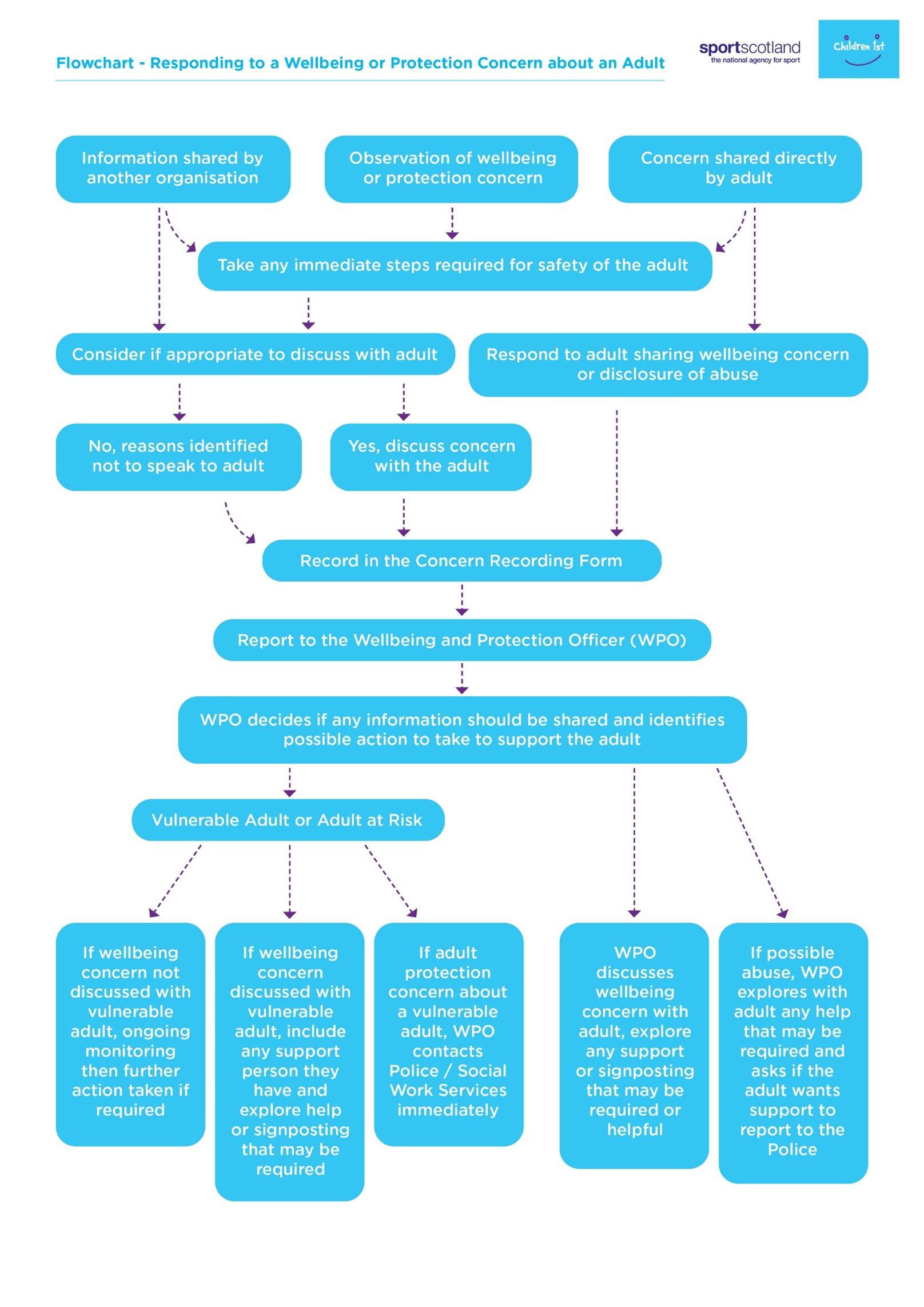
There are two key procedures to follow when there is a concern about an adult’s wellbeing or protection:
In both situations, we need to distinguish if there is information known about the adult as defined in the Risks to Adult’s Wellbeing section where Vulnerable and Protected Adults are described. This is because we understand the need for additional support and protection for these adults, which will determine some decisions made when responding to a concern.
This procedure ensures that everyone involved in Mountaineering Scotland or affiliated club activities are clear on what action to take in the event of a wellbeing or protection concern being raised about an adult. It provides clear, important steps to follow, ensuring action is taken quickly and in the best interest of individuals involved. There are a few ways in which information could be shared with us, that we would then respond to. An adult could directly share with us a wellbeing or protection concern about themselves. Another individual may have observed something, then share their concern about an adult with us. Or an organisation may share information about a wellbeing or protection concern about an adult. We will then consider action by determining if it is a wellbeing or protection route to follow.
Wellbeing concerns will be discussed with the adult if appropriate, and their views considered. However, if an adult is vulnerable or at risk, it may be more appropriate to speak to someone who supports them. This will be considered for each relevant individual, where on some occasions, it could be decided not to speak to a vulnerable adult directly, but a record should still be kept of any concern and decision reached not to speak to them at that time, with the reasons clearly explained.
The best interest of the adult concerned should be central when considering the best way forward. Where appropriate, consent should be gained from the adult regarding future actions and further support.
At any point, if there is uncertainty about the appropriate course of action, advice should be sought from the Wellbeing and Protection Officer.
2. Record
A written/electronic record of the wellbeing concern will be recorded on Part A of the Concern Recording Form, completing as much of the form as possible.
3. Report
All wellbeing concerns will be reported to the Mountaineering Scotland safeguarding@mountaineering.scot and/or Club WPO as soon as possible and the appropriate course of action agreed. Depending on the needs and discussion with the adult, relevant support and help will be sought, or signposting to other services shared. Where the form is received electronically, it will be password protected and saved to a file that is only accessible by the WPO for Mountaineering Scotland. Any paper copies of the Concern Recording Form will be confidentially destroyed once all information is recorded electronically.
1. Respond
Allegations of abuse or neglect will always be taken seriously. If an adult says or indicates they are being abused or neglected, or information is obtained which gives concern that an adult is being harmed, the information will be responded to on the same day. If an adult discloses abuse:
Good Practice:
Agreeing to keep private and confidential if the adult is vulnerable or at risk.
If you are concerned about the immediate safety of an adult: Take whatever action is required to ensure the adults immediate safety. Pass the information immediately to the police and seek their advice.
A written/electronic record will be made of the information completing Part A of the Concern Recording Form, completing as much of the form as possible. Reporting concerns will not be delayed by gathering information to complete all sections of the form. It is important to record the actual words used by the individual, even if this makes you feel uncomfortable.
The information will be passed to the WPO immediately (or second named person if not available). If neither is available, when an immediate response is required, the Police and/or Social Work Services will be contacted directly. Otherwise, the WPO will pass this information onto the Police or Social Work Services without delay and take advice about the next steps. Any advice will be recorded.
Where the form is received electronically, it will be password protected and saved to a file that is only accessible by the WPO for Mountaineering Scotland and the Chief Executive Officer. Any paper copies of the Concern Recording Form will be confidentially destroyed once all information is recorded electronically.
The information in the Concern Recording Form will help the WPO, Police and Social Workers to decide what action to take next.
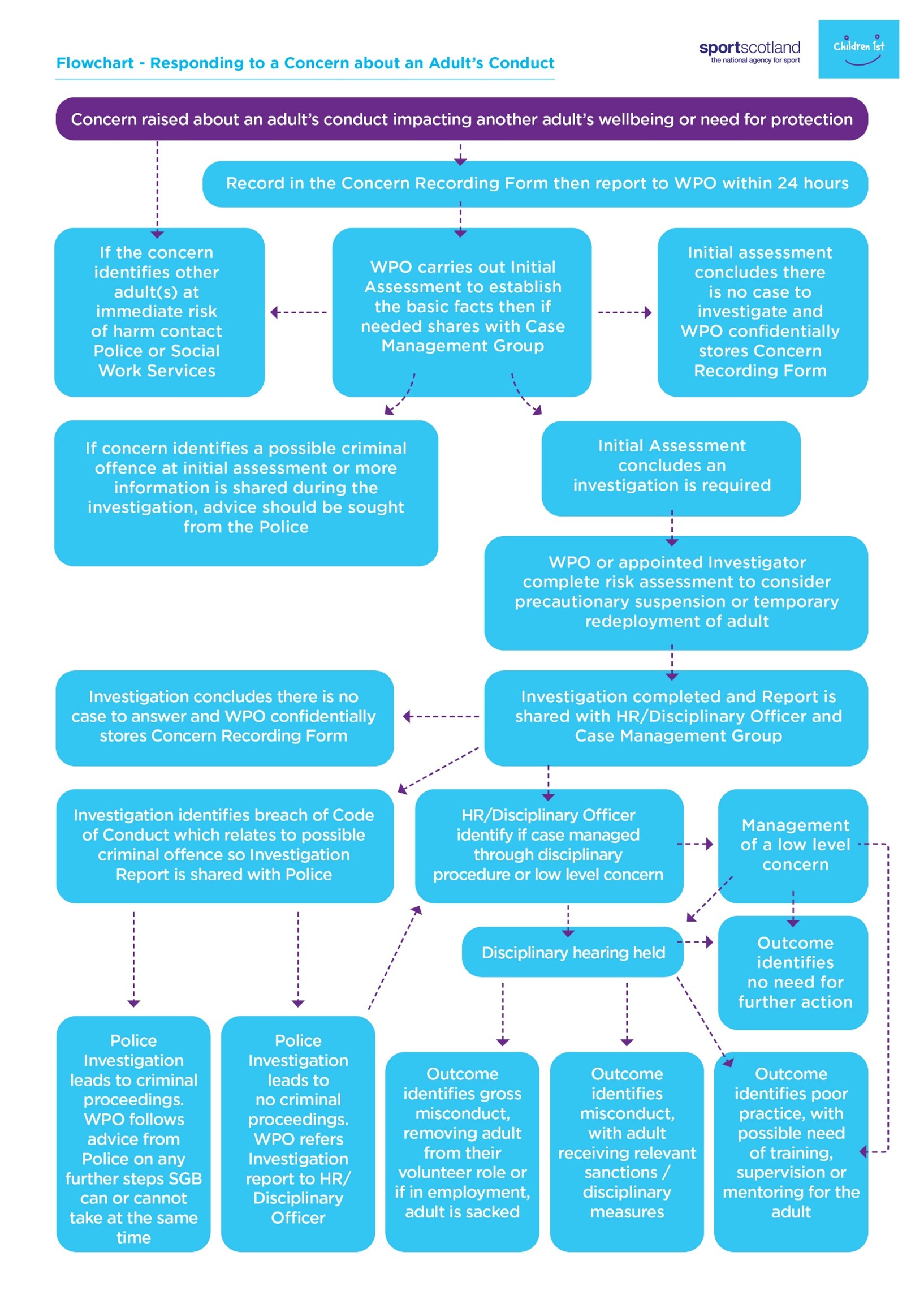
At any point in responding to concerns about the conduct of an adult, advice may be sought from the Police or Social Work Services if there is concern over a possible criminal offence.
No board member, member of staff, volunteer, official, athlete, coach or participant in receipt of information that causes concern about the conduct of an adult towards any other individual shall keep that information to themselves; or attempt to deal with the matter on their own.
1. Record
A written/electronic record of the concern will be recorded on Part B of the Concern Recording Form. Reporting of concerns will not be delayed by gathering information to complete the form or to fully complete it.
2. Report
All concerns about the wellbeing of an adult arising from the conduct of another adult will be reported to the WPO on the day the concern arises, as soon as practically possible. Where the concern is about the WPO it must be reported to the Chief Executive/other named individual. Actions taken and reasons for decisions will be recorded, in the order in which they happen, on the Concern Recording Form. This will be signed and dated by the WPO, or the person appointed to manage the response process.
Where the form is received electronically, it will be password protected and saved to a file that is only accessible by the WPO and [insert remits of others with access]. Any paper copies of the Concern Recording Form will be confidentially destroyed once all information is recorded electronically.
3. Conducting an Initial Assessment
Once the concerns have been reported, the WPO, or the person appointed to manage the response process will:
The outcome of the initial assessment will conclude there is either no case to investigate or an investigation is required. On some occasions, there may be a need to facilitate a discussion where the concern reported represents a possible disagreement or clash of personalities. This type of situation would not progress to an investigation; however, the Concern Recording Form can be updated with details of the resolution reached.
Where no case is identified, the WPO will still confidentially store the Concern Recording Form for any future concerns that may be raised about the same adult, should this indicate some low-level concerns or a pattern of behaviour that may need addressed in future.
Where the outcome of the initial assessment identifies the need for an investigation, either the WPO leads or appoints an Investigator. Before starting the investigation, a risk assessment will be completed in considering if the adult whose conduct is being questioned, should continue in their role or if precautionary suspension/temporary redeployment is required to manage any risk. The adult will then be informed of this decision and made aware that an investigation will take place in response to the concern raised about their conduct. It should always be made clear that any precautionary suspension or temporary redeployment in place is not a form of disciplinary action and is considered as a precaution without prejudice.
If the initial assessment identifies possible criminal offence, advice should be sought from the Police before an investigation is started.
4. Undertaking a Wellbeing and Protection Investigation
A Terms of Reference and Investigation Plan will establish the content and purpose of the investigation. This should be agreed between the WPO/Investigator and HR/Disciplinary Officer. The Case Management Group may also be consulted. The investigator will then interview relevant people and gather/analyse evidence to determine if the concern raised about the adult’s conduct is factual and corroborated.
If during or at the end of the investigation, information gathered gives reasonable cause to suspect an adult’s behaviour has been a criminal offence, the WPO will immediately share the investigation findings with the Police. The name and designation of the Police Officer to whom the concerns were passed, together with the time and date of the call/correspondence, will be recorded by the WPO. Advice given by the Police will then be followed in relation to any further contact made with the individual and any further action the WPO can take within Mountaineering Scotland or an affiliated club.
An outcome of the investigation could identify there is no case to answer, where the WPO will confidentially store the Investigation Report. All parties involved, whether raising the concern or being the subject of the investigation will be informed of the conclusion with no further action being taken.
In sharing the Investigation Report with HR/Disciplinary Officer and Case Management Group, it could be decided that while disciplinary action is not required, a breach of Code of Conduct in relation to poor practice or inappropriate behaviour could be managed through a Low-Level Concerns policy. This could mean that training, supervision or mentoring of the adult could be an appropriate measure.
If however, disciplinary procedures are decided as the next stage, a Disciplinary Hearing will be arranged to consider the information collated and identified in the Investigation Report, and possible disciplinary actions for the adult.
5. Disciplinary Hearing
The WPO/Investigator may have a role in the hearing if they are asked to share the findings and any recommendations from the Investigation Report. This process will follow Mountaineering Scotland’s Disciplinary Procedures as led by the HR/Disciplinary Officer.
Depending on the outcome of any criminal proceedings; there may still be the need or opportunity for a case to be referred to a Disciplinary Hearing. This will only take place on the advice from Police that it is safe to do so and there will be no impact on any criminal proceedings yet to be concluded.
Possible outcomes of the disciplinary process include no further action, poor practice, misconduct, or gross misconduct being identified with their relevant actions, sanctions, and consequences. Where an adult is removed from their role or banned from the sport, the WPO should identify if that adult has previously been involved in any aspect of the sport with children and young people, to consider if the information should be shared with Police or Disclosure Scotland.
It should have been explained in writing and verbally to the adult who is the focus of the concern and the person raising the concern that there is an appeal process should either party want to appeal against any of the disciplinary hearing outcomes as contained within Mountaineering Scotland’s Disciplinary Procedures.
6. Safe Environments
Ultimately, the conclusion of any concern raised about an adult’s conduct should ensure that action results in managing any behaviours that impact or risk affecting other adult’s wellbeing and experience within Mountaineering Scotland or affiliated club activity.
Any decisions reached should be monitored and recorded across defined timescales by the WPO and any other designated adults supporting the outcomes.
Further information and resources can be found here.
The section below outlines key definitions noted within this document and aims to provide support in recognising, identifying, and addressing abuse, neglect, bullying and harassment within sport.
“Adults at risk” are adults who are aged 16 years and over who:
(a) are unable to safeguard their own wellbeing, property, rights or other interests,
(b) is at risk of harm, and
(c) because they are affected by disability, mental disorder, illness or physical or mental infirmity, is more vulnerable to being harmed than adults who are not so affected.
A protected adult is defined as an individual aged 16 or over who is provided with (and thus receives) a type of care, support, or welfare service. There are four categories of services, receipt of any one of which makes an individual a protected adult:
1. Registered care services: A service by a person carrying out: (a) a support service; (b) an adult placement service; (c) a care home service, or (d) a housing support service.
2. Health services: A service provided or secured by a public health body concerning the treatment, care and support of, and provision of advice and assistance to, individuals in relation to health and well-being, or similar services provided by an independent health care service provider.
3. Community care services: Social work and mental health services provided or secured by a council, or self-directed support paid for by a council.
4. Welfare services: A welfare service includes any service which provides support, assistance, advice or counselling to individuals with particular needs, meeting the following conditions. The service must be a service that:
| Physical |
|---|
Physical abuse can be considered as any individual intentionally or knowingly using physical force or contact against another individual in an unwanted and non-consensual manner. Physical abuse includes any contact or non-contact action that inflicts harm or pain on the body. As well as direct physical abuse such as assault, or unauthorised physical contact, in sport physical abuse can also look like:
Encouraging or promoting eating disorders, fasted training, disordered eating. Commenting negatively on athletes’ bodies which has a direct impact on the athlete’s body. |
| Sexual |
Sexual abuse is any contact or non-contact sexual activity that happens without consent or understanding, or without forced consent. Sport is inherently physical and so contact between athletes and coaches in normal. This can be used as a pretext for sexual violence. Many people with lived experience have reported that the sexual violence they experienced followed, or happened during, legitimate physical contact such as sports massage or physiotherapeutic and medical examinations. |
| Psychological |
Psychological abuse is behaviour that aims to cause emotional or mental harm. In sport it is important to note that promoting disordered eating by commenting on athletes’ body composition, weight, judging what they eat, suggesting leaner is better also constitutes psychological harm. |
| Neglect |
Neglect is the ongoing failure to meet an individual’s basic and essential needs, either deliberately, or by failing to understand these. It includes ignoring a person’s needs or withholding essentials to meet needs, such as medication, food, water, shelter and warmth. |
| Financial |
Financial abuse is a form of abuse when one individual has control over another’s access to economic resources, which diminishes an individual’s capacity to support themselves and forces them to depend on the perpetrator financially. It can also include someone manipulating or coercing someone into giving them money or having control over someone’s finances. |
| Institutional |
Institutional abuse is the mistreatment or neglect of an adult at risk by a regime or individuals. It takes place within settings and services that adults at risk live in or use, including any organisation, in or outside the Health and Social Care sector. Institutional abuse may occur when routines, systems and regimes result in poor standards of care, when poor practice and behaviours are in place, within strict regimes and rigid routines which violate the dignity and human rights of the adults and place them at risk of harm or within a culture that denies, restricts or curtails privacy, dignity, choice and independence. |
Every individual has the right to experience sport in a safe environment, free from bullying and harassment. We understand that adult’s wellbeing can be seriously impacted by bullying and harassment and the importance of being able to identify when this could be taking place in a sporting context.
| Bullying |
|---|
Bullying, as defined by Respectme, Scotland’s Anti-Bullying Service is ‘behaviour that can make people feel hurt, threatened, frightened and left out and it can happen face to face and online’. In a sporting context bullying could include:
A coach yelling, criticising and humiliating players, creating a hostile environment and instilling fear in the team. |
| Harassment |
Harassment as defined by ACAS is ‘Unwanted conduct that violates people’s dignity or creates an intimidating hostile, degrading, humiliating or offensive environment’. Unwelcomed or offensive behaviour that targets individuals based on factors such as race, gender, sexual orientation, religion, disability or other protected characteristics. |
The section below provides further information on key legislation noted within this document. This list is not exhaustive and further information can be found using the links below.
| The Adult Support and Protection (Scotland) Act 2007 |
|---|
The Adult Support and Protection (S) Act 2007
was introduced to protect adults who may be at risk from harm from others. It
provides greater protection to adults at risk of harm through powers to
investigate and act to support and protect adults where concerns exist and
places a duty on specified organisations to investigate suspected or actual
harm. The main principle is that any intervention in an individual’s affair
should provide benefit to the individual and should be the least restrictive
option of those that are available. |
| The Adults with Incapacity (Scotland) Act 2000 |
The Adults with Incapacity (S) Act 2000 provides a framework for supporting the wellbeing and protection of adults who lack the capacity to make decisions for themselves. The Act aims to balance the protection of vulnerable individuals, respecting their rights and autonomy while supporting decision making in their best interests when they are unable to do so themselves. |
| The Children and Young People (Scotland) Act 2014 |
The Children and
Young People (S) Act 2014 aims to improve outcomes for children and young
people by promoting their wellbeing, safety, and rights. The relevance for
adults is with respect to care experienced young people and adults, where
corporate parents continue to have legal responsibilities up to the age of 26
years as stated in Part 9. |
| Data Protection Act 2018 |
The Data Protection
Act 2018 was introduced to provide regulation of the processing of information
relating to individuals; to make provision in connection with the Information
Commissioner's functions under certain regulations relating to information; to
make provision for a direct marketing code of practice; and for connected
purposes. |
| Domestic Abuse (Protection) (Scotland) Act 2021 |
The Domestic Abuse
(Protection)(S) Act 2021 aims to address domestic abuse in Scotland. It
introduced measures such as Domestic Abuse Protection Notices (DAPNs) and
Domestic Abuse Protection Orders (DAPOs) to protect victims. The Act supports
victims and promotes training of professionals to enhance support and responses
to domestic abuse cases. It also ensures that protection measures are
recognised and enforced. |
| Equality Act 2010 |
The Equality Act aims to protect individuals from discrimination and promote equal opportunities in various aspects of life. It prohibits discrimination based on characteristics including: age, disability, gender reassignment, marriage and civil partnership, pregnancy and maternity, race, religion or belief, sex and sexual orientation. The Act covers both direct and indirect discrimination, harassment, and victimisation. |
The SEND (Special Educational Needs and Disabilities) Code of Practice is a set of guidelines in the UK that provides statutory guidance for organisations, schools, and local authorities on how to support children and young people with special educational needs and disabilities. It outlines procedures for identifying and assessing SEND, as well as strategies for providing appropriate support and adapting to meet individual needs. |
The section below provides a list of organisations that provide a variety of support and resources on key areas noted within this document. For more information about how the Case Management Support Service can support you - visit: www.childrenfirst.org.uk/cmss, call 0300 373 1080 or email cmss@childrenfirst.org.uk
| Resource | Contact Information |
|---|---|
| Police - Emergency | 999 |
| Police - Non-emergency | 101 |
| Army of Survivors |
|
| Athlete Interactions | athleteinteractions.org |
| Care Information Scotland | |
| Kyniska Advocacy | kyniskaadvocacy.com |
| Men’s Advice line | 0808 801 0327 |
| Modern Slavery Helpline | 0300 0121 700 (24 hours) |
| National Lesbian, Gay, Bisexual, Trans+, Domestic Abuse Helpline | 0800 999 5428 |
Open Secret | |
| Refuge – National Domestic Abuse Helpline |
0808 2000 247 (24 hours) |
| Scottish Women’s Aid Helpline | womensaid.scot Helpline: 0800 027 1234 |
| Sporting Minds | |
| The Defendant | thedefendant.org.uk |
| Victim Support Scotland, Scottish Helpline | 0800 160 1985 |
Who Cares? Scotland Helpline |
0330 107 7540 |
| Respectme |
0344 800 8600 |
Information should be handled and disseminated on a need-to-know basis only. This may include the following people:
Information storage and handling
Information should be stored in a secure place with limited access to designated people, in line with data protection laws (e.g. that information is accurate, regularly updated, relevant and secure).
In relation to any information regarding a Child Protection concern, it is recommended that this information should be retained for 25 years (from the date of birth of the child) and 10 years for any adult behaviour (this starts once the adult has left the club/employment).
For low level concerns it is important to consider proportionality and only keep the information for as long as it is necessary. It is important to think about why the information is being retained, for what purpose it might be needed and what the risks are if the information is kept or destroyed.
Destroying information
Hard copies should be destroyed using a Din level 5 micro cut shredder and for digital copies you would delete the data and empty the recycling bin. If you have a back-up solution for your electronic records, you should also delete any records from your backups as well.
© 2026 Mountaineering Scotland
ClimbScotland is a registered trademark of the Mountaineering Council of Scotland Limited
Mountaineering Scotland is a registered trademark of the Mountaineering Council of Scotland Limited


