
Friday 28th August 2026, 9:20am
We know that maintaining
access to Scotland’s hills and crags remains one of the top priorities for our
members. Much of this work is behind the scenes and some issues can take a long
time to resolve so we wanted to take this opportunity to update members on some
of the key cases that we are currently working on.
It’s important to note these are only a few of the bigger cases we have open and we also respond to member queries and concerns about lower-level access issues which require us to liaise with local authority access officers. We also represent our members at the regular meetings of the National Access Forum which is the national body established by Nature Scot to advise on access issues.
Jump to:
Although there is now a year-round season for stags in Scotland, the first three weeks of October is a key period for stag stalking whilst mid-January to mid-February is the busiest period of the hind cull. Deer are alert to human activity from a considerable distance, often long before a walker is aware of them, and during these periods we should take particular care to avoid disturbance. To help plan your activities during the stalking season visit the Outdoor Access Trust for Scotland website for detailed information on stalking activity.
The recent Ramblers petition regarding North Chesthill Estate in Glen Lyon has generated a lot of interest about this longstanding access issue. We know this case is important to our members and Mountaineering Scotland has been actively involved for almost three decades now with our original file going back to 1996. We agree that the landowner’s actions, in actively discouraging even responsible access for two months or more every year, are not in line with the Land Reform (Scotland) Act 2003 or the Scottish Outdoor Access Code. There have been numerous attempts to come to a compromise with the landowner, but sadly none of these have resulted in a long-lasting solution.
If you are planning a visit to the Munros north of Invervar, N Chesthill our advice is to follow the established circular route, sticking to the ridges and avoiding the corries, except in an emergency.
We would also be very interested to hear about your experience, in particular;
We are continuing to liaise with the Outdoor Access Team at Perth & Kinross Council and the Local Access Forum and have been sharing information and evidence from our records, to support their discussions with the landowner. It is important to stress that the approach taken by the owners of North Chesthill is out of step with the approach taken by other estates across Scotland who we have a very constructive relationship with, recognising that deer stalking plays a critical role in tackling nature loss and climate change.
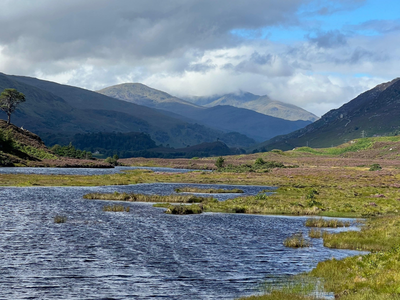
The first of November marks the start of our winter access arrangements in Glen Strathfarrar. The winter season, from November through to March, is a busy period for the stalking in the glen, so the private glen road is closed to the public.
Our normal rights of responsible access still apply, so anyone can walk or cycle up the glen as usual. However, Mountaineering Scotland continues to work with Culligran, Braulen and East Monar Estates estates in the glen to gain permission for our members to take a limited number of vehicles up the glen to walk and climb. For more updates, visit this page.
The 1st of April saw the introduction of the new Fire Management Byelaw in Cairngorm National Park. Cairngorm National Park Authority (CNPA) undertook an extensive consultation on the Byelaw prior to its implementation, which Mountaineering Scotland took part in. Our request for clarity around the use of camping stoves and fireplaces and stoves in bothies was taken on board and a specific section for mountaineering club huts was included within their guidance for owners which is available here.
Following the tragic wildfire that occurred over the summer we have been part of the multi-agency communications group to support the reopening of public access, and we continue to liaise with CNPA on recommending safe routes and highlighting areas to avoid. See their interactive map for current open/closed routes and the full exclusion zone.
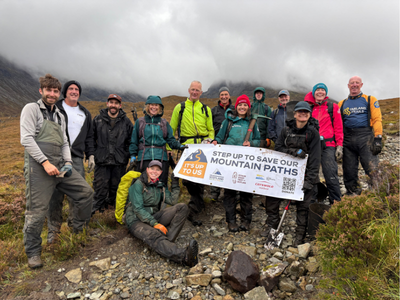
Earlier this year we celebrated the completion of a £300,000 project to repair the path up An Teallach. We are now looking for your help in choosing another mountain path to be the focus of our next project. We are specifically interested in paths on a mountain (or hill), with a summit height of over 600m. The focus of the campaign is on mountains that are situated on private land, outwith the National Parks, where there is no access to government funds. If you know of a mountain path that needs repair, let us know here.
In 2025, a team of volunteers from Mountaineering Scotland, British Mountaineering Council and Outdoor Access Trust for Scotland spent three days in Glen Brittle, Skye, carrying out valuable path maintenance. Together we cleared 122 cross drains, improved 4kms of mountain paths and planted 200 native trees. It was such a success we’re returning to the glen in September to see what more we can do.
We raised members’ concerns about restrictions on overnight parking in this car park, which is popular with visitors to the CIC Hut and others spending the night on the mountain. Forestry & Land Scotland (FLS) who own and manage the site had responded to concerns from local residents about high levels of use by motor homes, campervans and car campers and the associated waste in the vicinity.
Their long-term solution was to propose a new, larger car park nearby and they applied for planning permission in December 2022. Highland Council’s South Planning Applications Committee finally considered the application in June of this year. However, the Committee voted to postpone their decision on this application until after a site visit, the stated purpose of which is to better understand the road safety implications. SMC’s and MScot’s comments were acknowledged by the planner in her presentation and one of the Councillors mentioned overnight parking for CIC Hut users several times during the discussion to we’re confident our point of view has been heard and understood.

We have been representing hillwalkers and climbers heading to Buachaille Etive Mòr and surrounding area on the Altnafeadh Parking Working Group. This group is working together to find a solution to the increasingly dangerous parking situation by the A82 at Altnafeadh, close to Lagangarbh. The Board of Mountaineering Scotland agreed a contribution of £2,000 to support the commissioning of a feasibility study to evaluate potential locations and likely costs of the various options that have been proposed. We now have the draft report and will continue to be involved in discussing the next steps. It’s positive to be making some progress towards a sustainable, long-term solution for this issue.
If you’ve been following the Radical Road case you will be pleased to know that planning permission for the installation of new fencing and the removal of some of the old fencing, which would allow climbers back into the South Quarry for the first time since 2018 has been granted. This is another longstanding access case we have been actively involved in since the fences were erected. We have reached out to Historic Environment Scotland (HES) staff at Holyrood Park to find out when the work is likely to take place and the details of the revised climbing permits system and look forward to providing a further update when we have more information.

There has been a significant rock fall Wolfcrag Quarry recently, a popular crag at Bridge of Allan, near Stirling. This has left a very unstable block at the top of the rock face, that could come down at any moment. The area has been cordoned off, and we advise everyone to keep clear for the time being. We have been in touch with the Access Officer at Stirling Council, who own the land. She has confirmed that, at the request of their Engineering Team, the site will remain cordoned off for safety reasons until their Senior Engineer has assessed the site and made a longer-term plan. We have asked that we’re kept updated and that the climbing community as well as the local community is included in their consideration and in any community consultation that takes place.
If you would like to know more about your access rights and responsibilities, check out the Access pages on our website. If you have a specific access query, contact our Access & Environment Officer, Catriona Davies via access@mountaineering.scot.
© 08/1 Mountaineering Scotland
ClimbScotland is a registered trademark of the Mountaineering Council of Scotland Limited
Mountaineering Scotland is a registered trademark of the Mountaineering Council of Scotland Limited


